What's actually causing it.
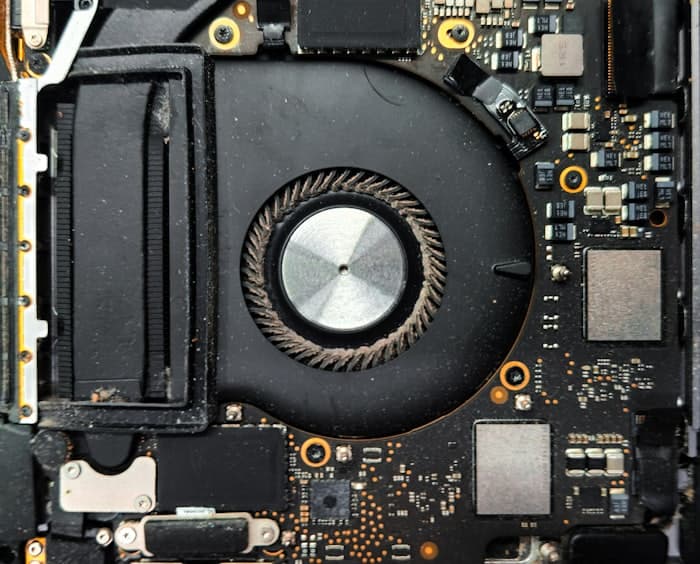
A heatsink like this is why a three-year-old laptop throttles, runs loud and shuts down under load — and it's a clean, not a new machine.
Laptop won't turn on / no display
Likely cause: Often a dead CMOS battery, a loose RAM stick, or a motherboard power-delivery fault — not always the screen itself.
What we do: We check power delivery first, reseat RAM, and test the panel separately before quoting any board-level repair.
Random blue screen (BSOD) or reboots
Likely cause: Usually a driver conflict, corrupted system file, or early-stage RAM/SSD failure.
What we do: We run a memory diagnostic and check drive SMART health to isolate hardware from software before reinstalling anything.
Overheating, loud fan, sudden shutdowns
Likely cause: Dust-clogged heatsinks and dried-out thermal paste — the most common cause after 2–3 years of daily use.
What we do: Full strip-down clean, fresh thermal paste, and a fan RPM check under load.
Data lost after formatting or a drive won't mount
Likely cause: Logical failures (accidental deletion, formatting, corrupted partition table) are usually recoverable; physical failures (clicking noise, not detected in BIOS) are not always.
What we do: We diagnose which type it is first and give an honest recovery estimate — we won't promise recovery on a physically damaged drive.
Wi-Fi keeps dropping or has dead zones
Likely cause: Channel congestion, outdated router firmware, or poor access-point placement.
What we do: We reconfigure channels, update firmware, and test signal strength room by room.
Battery drains fast, or won't charge
Likely cause: Li-ion batteries degrade after 300–500 charge cycles; a swollen battery is a safety risk, not just a nuisance.
What we do: We test actual charging voltage at the port before assuming it — a worn port or failing power IC is sometimes the real cause, not the battery.