CHIP-LEVEL / BOARD-LEVEL REPAIR

We repair the motherboard. Most shops just replace it.

When a board fails, the easy answer is a full motherboard replacement — and on most laptops that costs a serious share of what the machine is still worth. Chip-level repair fixes the component that actually failed, which is usually a part worth a few rupees sitting on a board worth thousands.

Call +91 83838 61528WhatsApp us

Faults we repair at component level.

Dead short on a power rail

A shorted MOSFET, capacitor or IC drags the whole board down. We find the exact component pulling the short instead of condemning the board.

Missing 3.3V / 5V always-on rails

A failed regulator or PWM controller means the board never wakes up. Looks identical to a "dead motherboard" — it usually isn’t one.

Charging IC / PMIC failure

Plugged in, no charge, no power. Often the charging IC or a blown sense resistor rather than the battery or the adapter.

BIOS / SPI flash corruption

A corrupted BIOS chip can be re-programmed on the bench — no board swap needed, and no data touched.

Liquid damage corrosion

Cleaned properly, corroded components replaced and traces treated — the sooner it comes in after the spill, the more survives.

Broken DC jack or USB port

Re-soldered at the pad. If pads have lifted, we rebuild the trace rather than telling you the board is finished.

How we find the fault

  • 01Bench DC supply reads the board’s current draw before anything is opened — that alone separates a short from an open circuit.
  • 02Multimeter checks the 3.3V, 5V and VCORE rails against the schematic to find which stage of power delivery stops.
  • 03Thermal camera or freeze spray locates the component actually heating up under the short.
  • 04Boardview and schematic diagrams trace that rail back to the specific part responsible.
  • 05Hot-air rework station and microscope for the SMD or BGA replacement, then re-test under load.
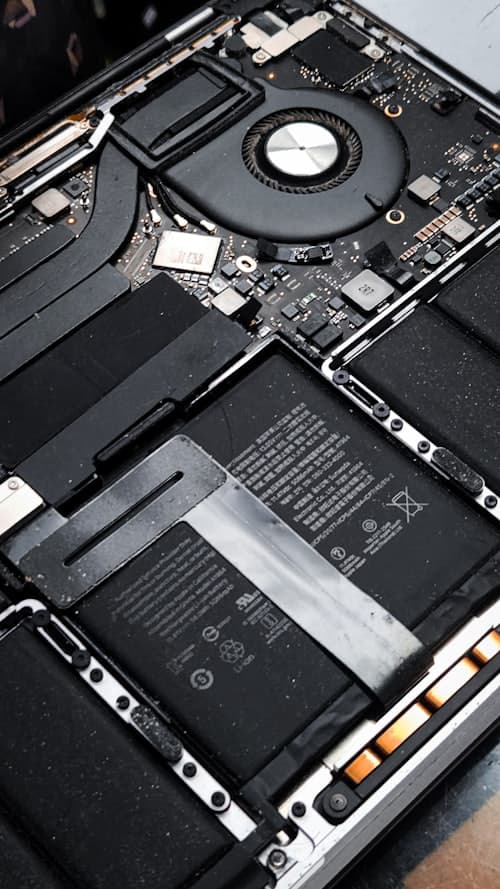
A laptop opened up showing the motherboard, cooling fan and battery
Not every board is worth saving: burnt traces buried under a BGA, severe multi-layer liquid damage, or a failed CPU/GPU die can cost more to attempt than the laptop is worth. In those cases we say so — and we don't charge you for a repair we don't believe in.

Sometimes the honest answer is “don't repair it”.

This is the rule we apply to your device before we quote you.

WORTH REPAIRING

The fix costs well under half of a comparable replacement, and it’s one clear fault rather than a machine failing in several places.

WORTH A CONVERSATION

The repair lands near half the replacement cost — then the age and remaining life of the battery, drive and hinges decide it.

BETTER TO REPLACE

Older machine, multiple failures, or a repair approaching the cost of a new device. We’ll say so — and still move your data across.

Board-level repair questions.

What is chip-level repair, and why does it matter?
Instead of replacing an entire motherboard, chip-level (board-level) repair fixes the individual component that failed — a shorted MOSFET, a dead charging IC, a failed voltage regulator. Since a replacement board often costs a large share of what the laptop is still worth, repairing the board is usually far cheaper when the fault allows it.
My laptop is completely dead. Is the motherboard gone?
Usually not. A board that shows no sign of life most often has a shorted component on a power rail or a missing always-on voltage — both repairable. We measure the current draw on a bench supply before concluding anything about the board.
I spilled liquid on my laptop. What should I do?
Power it off, don't try to charge it, and bring it in as soon as you can — corrosion keeps spreading while the board sits wet, so time matters more than anything else here. Rice does not help; a proper clean does.
Should I repair my old laptop or just buy a new one?
Our rule: if the repair costs well under half of what a comparable replacement would, repairing is usually the better value. If it's approaching that, we'll walk you through the machine's age and remaining life instead of just quoting you.
How long does a board-level repair take?
Typically 2–4 days. Diagnosis is the quick part; the wait is usually sourcing the specific component for your board.
Book a diagnosis